Message
IN
From
Ignotus NemoProofs establish validity. PoW sets canonical order.
One transparent end-to-end post-quantum stack.
Bitcoin, Ethereum, Solana, Zcash, TRON, and most blockchains derive their current state from accumulated history. Some replay it directly, others shorten bootstrap with snapshots or checkpoints. Either way, a new verifier must reconstruct or inherit the path to the current state.
Parano1d separates state validity from historical replay. The live State holds value and commitments to programmable spending rights, authenticated by a recursive proof from genesis. Spent outputs release their slots, so storage follows live use rather than chain age.
Peers provide data, not authority. A node receives the live UTXO state, its matching terminal proof, and the latest 18-block reorg suffix. It authenticates the state, verifies the suffix, and joins the network as an independent full node. The procedure is the same in year one and year ten.
In Parano1d, each proof is built where the required information already exists. The network receives a verifiable result, not a computation to repeat.
Spending clears a slot. The allocator reuses empty positions before expanding the state. A segment becomes virtual again when its last UTXO is spent.
creation_id to an empty positionParano1d begins with 256 bits of secret entropy, not a public-key pair. The wallet proves knowledge of that secret without revealing it, and every spend produces a fresh zero-knowledge proof bound to the complete transaction.
A Parano1d wallet can generate a new master secret, import an existing one, or derive one from a private image. Photo Key reads the image locally, never uploads it, and keeps no copy. The same decoded pixels recreate the same 256-bit secret and every address derived from it. Change the pixels, and you get a different wallet.
Each Tx8x2 page holds eight inputs and two outputs. PagedSpend joins pages into one atomic transaction with one txid, fee, authorization capsule and receipt. V2 admits up to 504 inputs within the block budget: at most 63 pages in Small, or 128 pages for one logical transaction in Large.
Each HistoryStep proves the new block and verifies the preceding terminal within the same relation. The terminal changes with every block, but its size and verification work do not grow with chain height.
Parano1d is transparent while transactions pass through consensus: values, owners, and transactions are public. But consensus does not retain a permanent transaction graph. Long-term address tracking requires an external observer to record the stream continuously and store it independently.
When a payment confirms, the sender's wallet saves an exportable Merkle receipt. It carries the complete public payment data and a fixed-depth inclusion path. Any node verifies it against the canonical header. The historical block body is not required.
Addresses, wallet authorization, transactions, state, recursive history and PoW share one binary proof stack. FROST-GKR folds repeated Poseidon2b structure into shared Boolean hypercubes; FRI-Binius closes the relation without a trusted setup.
GF(2^128) · Fiat Shamir challenges: GF(2^256)The v2 resource assessment covers wallet authorization, transactions, contract execution, exact State transitions, recursive ancestry and matrix retirement. Its composition and preprocessing premises are explicit in the security model.
2^173.3897612554174≈ 0.04937388373372754 < 1/2PoW chooses the order of already-proven transitions. The miner completes the nonce-independent block proof, freezes an immutable template, then searches only the 128-bit nonce.
Small is the default. A producing server may enable Large with --v2-large-blocks when extra payment capacity is useful. Every node verifies both. Both classes share 504 live inputs and 63 contract calls; each call uses one page and one input. The block target is 30 seconds.
16 → 11.30 → 8 → 5.65 → 4 → 2.83 → 2 → 1.41 → 1 NOID. One step every 1,051,200 blocks from H210537; State occupancy still sets the slot-growth fee.
A live output can commit to a program, spending authorities and persistent counters. An authorized call proves the rules and creates the next valid state. The shared block proof carries continuity, so future nodes can verify the present after old interactions have been pruned.
Refundable payments, vaults, delegated allowances, period budgets, recurring payments and gradual unlocks are ready to use. Build custom programs through the GUI, CLI or API. Every application uses the same proved interpreter and block matrices.
Independent community
Independent software, services and other community-built resources.
01 / Native application
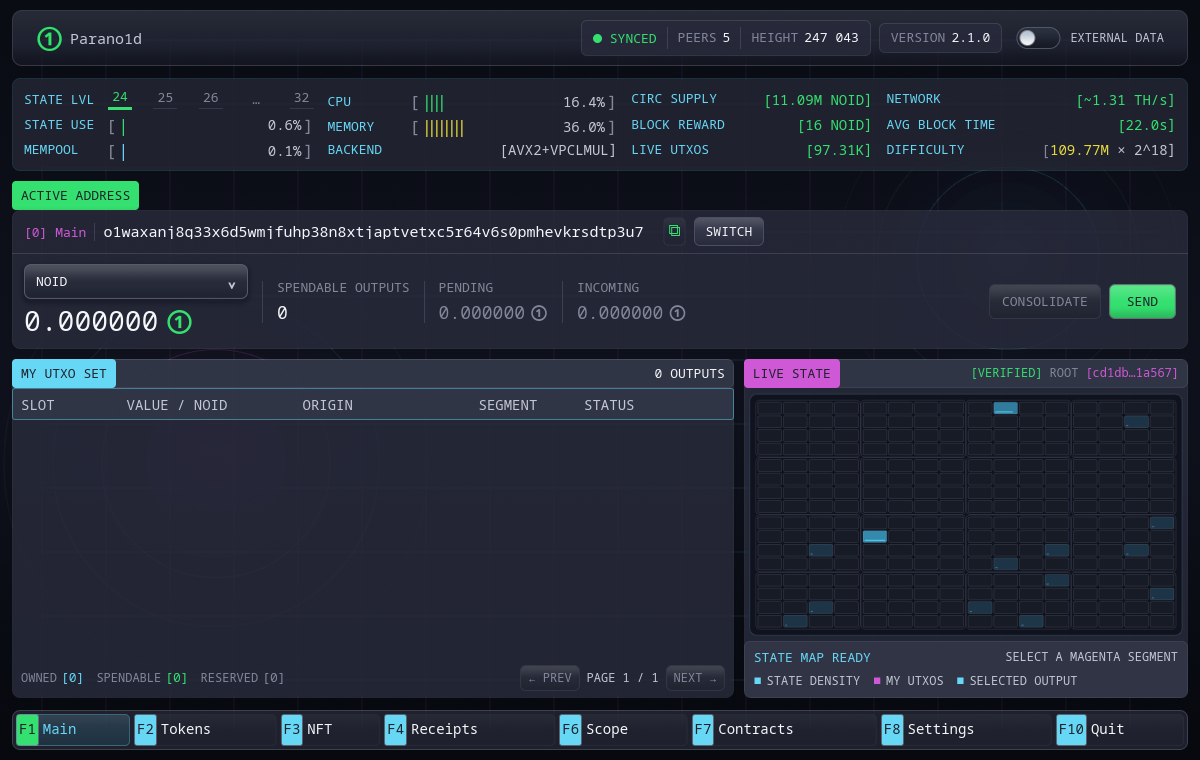
Install it like any desktop application. Create or restore one 256-bit secret, then use the wallet, private full node, Scope and miner without a terminal.
02 / Operators and miners
One archive. Three focused tools.
parano1dparano1d-cliparano1d-minerFor node operators, automation and a separate mining process. Each Core archive contains all three command-line binaries for its platform.
SHA256SUMS